A Third Message from THE HOUSE OF AFFORDANCES

IT ALL depends on how you are YARDED
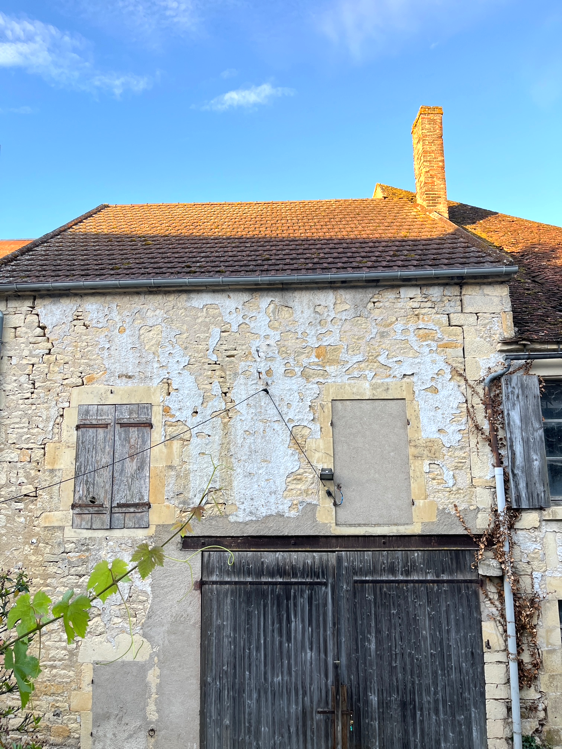 yarded at the French Wing, 6.32 am on June 6th
EXTRAVAGANCY?
‘It all depends on how you are yarded’, as Henry David Thoreau said.
How am I yarded? The above early morning 190º South view of the French Wing contains a lot of information on the subject of being yarded. It is taken on the 6th of June 2026, at 6.32 am, according to the date and time stamp of the photo. The exact location from which it is taken is 47.3670 N, 3.5903 E. I can tell today’s weather forecast is sunny for Tannay, Nièvre, France. The air is filled with the cooing of pigeons, the chirping of sparrows, and the occasional caw of a jackdaw.
On the table is Baptiste Morizot’s ‘Manieren van levend zijn’ (‘Ways of Being Alive’), laying on my iPad and Jan Hanlo’s ‘Een erwt zo groot als een voetbal is geen erwt’ (‘A pea the size of a soccer ball is not a pea’), laying on the Openbaar Kunstbezits ‘Kunstschrift’ (Public Art Collection’s ‘Art Journal’), issue 2 of 1989, to which I contributed ‘Over de ziel als object van de waarneming’ (‘On the Soul as an Object of Perception’), on the book of Samuel Thomas Soemmerring (1755-1830), entitled ‘On the Organ of the Soul’ (‘Ueber das Organ der Seele’, 1796), which I chose from the library of the Teylers Museum in Haarlem. The issue of Kunstschrift, ‘Kunstenaars in Teylers Museum’ (‘Artists in Teylers Museum’), curated by editor-in-chief Lily van Ginneken, is dedicated to artists’ publications that are inspired by the rich collections of the oldest public museum (since 1784) of the Netherlands.
Such a simple scene, containing so much yarding information!
Furthermore on the table: a tea, a madeleine cake and a Pim’s Original sponge biscuit. Q. wishes me goodmorning. ‘Remind me that we have to create a Room for the Soul in the main building.’
Not much later I take the shortcut to the Saturday market via the yard. Those heaps need our attention but now all of a sudden we are also faced with the problem of the soul, I worry. Soemmerring even approached Immanuel Kant (1724-1804) with a request to look into the matter. These men actually were contemporaries but never met chest-to-chest, to ‘discuss together’ (link to ‘Roland Barthes 1976-1977 Comment vivre ensemble Room’). According to Kant, the important question is whether the problem of the seat of the soul belongs to the science of philosophy or physiology. Which echoes in Michael Pollan’s recent question about the ‘seat’ of ‘consciousness’, in his book ‘A world appears’. 2025. I should check if he came across the Soemmerring-Kant correspondence and if I do not find it in his footnotes, bring it to his attention. Isn’t that what we’re contemporaries for?
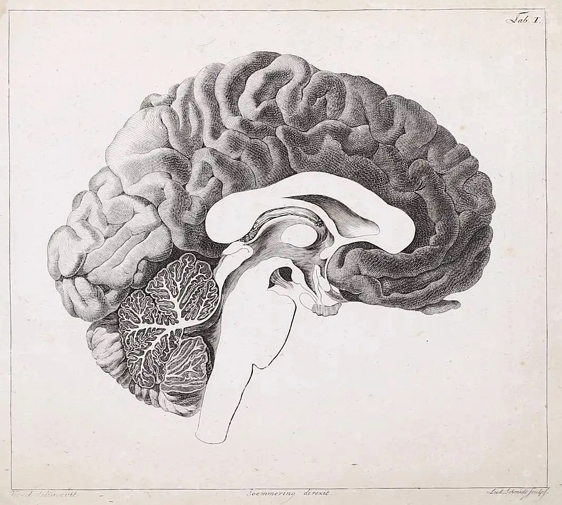 Soemmerring’s brain section, as mediated by artist Christian Koeck
Kant noted immediately that the ‘philosophy or physiology?’ point of contention should and can be entirely disregarded if, following Soemmerring, we conclude that we should not conceive of an object (a fixed part of the brain) as the seat of the soul, but rather of a continuous potential presence (‘virtuelle Gegenwart’) of this organ, as mere water (‘bloss Wasser’), which makes the union of the senses possible. The organization of this organ thus avoids the contradiction of perceiving itself through itself, which a fixed organ such as a ‘sensorium commune’ would face: the soul is a process rather than a thing: it cannot be observed as a thing, nor does it observe itself; it compares observations (Dutch-English DeepL-ed from my original text in Kunstschrift).
For me in my current enthusiasm for ‘connecting the dots’, dots are rooms (and from my conviction, carved in stone, that anything could and even will—whether we like it or not—inform anything else) I figure that I could engage with the seat of the soul through the heaps, which at the scale of the yard might seem relatively small, but for the shortcut to the market nevertheless demand adapted footwear.
Due to all the worrying and my unsuitable footwear I arrive late for the market. On the terrace of the Café Tribunal my neighbours have already changed their morning coffees for a kir apéro. Sitting at a slight distance, I drink two cappuccinos while continuing to work on above Byword notes on my phone.
Thinking about ‘being yarded’, I come to realize that in every game one’s position and attributes determine both the leeway and the relationship with the other players and how much one can apply the rules of the game in one’s own, or for that matter anybody else’s advantage.
‘So you consider the house of affordances a game space?’, Q. all of a sudden interrupts my train of thought. Of course he reads my mind, or rather his neurons fire alike, though following other prompts and paths. ‘House of Affordances is game space par excellence... it places imagination at the core of its gameplay. Its rules are as flexible and adaptable as its mechanics. The whole set up is aimed at mimicking real life limits, yarding, stretching envelopes and the magical border crossings that different interpretations of rules and conditions allow.
(to be continued)
A Second Message from THE HOUSE OF AFFORDANCES
MORE intimacy
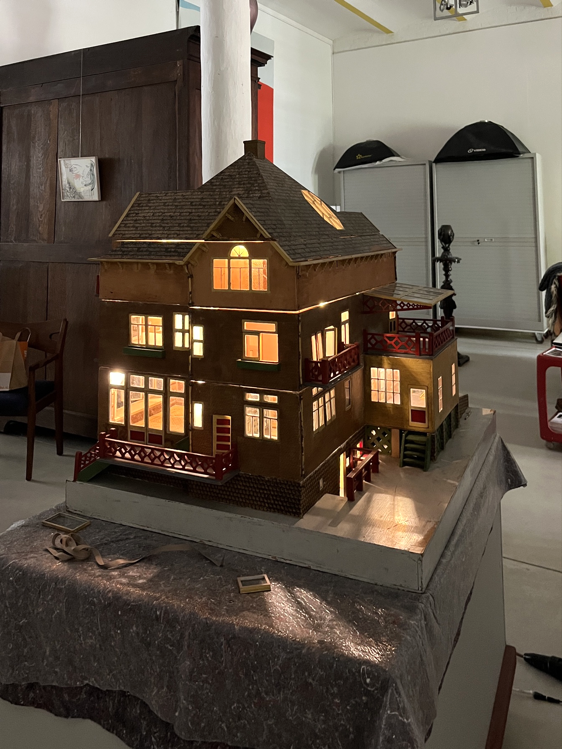 the affordance of electric lighting (photo taken at FHF’s studio)
Welcome to Small Heaps, where HoA is located for as long as anyone remembers. The house, < la maison >, is the mother of all souvenirs, as much as it is the mother of all models. June 30 coming will have a full moon.
Remember!
‘Small heaps, high hopes’, as the saying goes.
The longer we spend here, the better we understand what affordances this place allows—us. Allows-us. Affordances work on individuals. Of course right from when I moved in I invited avatar Quasime along to keep me company. Which makes two of me. Who would we be without them?
About Small Heaps
Small Heaps is an almost 2 hectares bumpy terrain, quite overgrown, yet evidently heapy. I try to model its natural development from memory. Such is Heaps, you know, they grow and erode and accumulate and let go. They are fertile at every level. They open both poetic and political space to no end. In the meantime Q. is dirtying his fingernails. Digging. Gardening. Sculpting. Landscaping. Pruning, and cutting grass like at Van de Wint’s De Nollen, allowing pathways to meander. Befriending the elements. Supporting living matter. Like a drawing that keeps on drawing, to no end, in every direction and dimension.
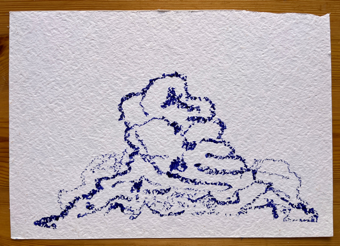 what a baby heap might have looked like (sketch), 2026
Sennelier oil pastel on stock Schoellershammer torchon paper
24×34cm, signed and available
Progressing over time. Lives support lives and ‘ways of being alive’ as in Baptiste Morizot’s Manières d’être vivant’, with its great Alain Damasio epilogue. This is how he reads Morizot.
How can we collectively develop a political approach that places care and attention to relationships—in all their breadth and complexity—at the heart of our actions? In other words, how can we—in our relationships with people as well as with other living beings—escape the urge to control and domesticate that has haunted us since the Neolithic era, and transition to an ethos of encounter and welcome? Toward a hospitality for the other-than-me, toward a circulating and cross-cutting empathy that does not, as we might think, destroy us but rather undoes destruction? In short, how do we arrive at those attuned expressions of respect—flexible and precise—for all that lives and yet differs from us, so as to combine their capacities once again with our own gifts (which, incidentally, we usually share with them)?
While quoting him in conclusion:
The human way of being alive—that enigma of enigmas—only takes on meaning in relation to the countless other ways of being alive, claimed by the animals, plants, bacteria, and ecosystems around us.
Hence no doubt that my heaps are a way-of-being-alive living affordance, offered right there in the yard. I just can’t stop looking at them. While—as I noted om my Instagram address—‘heaps complicate matter’. A heap is all about relationships, instead of objects, or matter, or stuff or all other kinds of distinct life forms.
The heap allows for connections between the alive, it is a living constellation, with to-no-end connections.
|
|
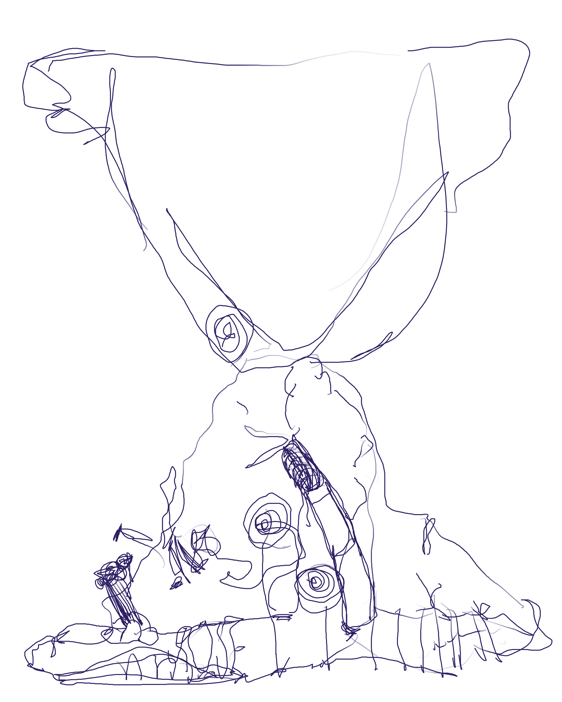 small heap first state Procreate drawing, 2026
digital drawing, various sizes and execution available
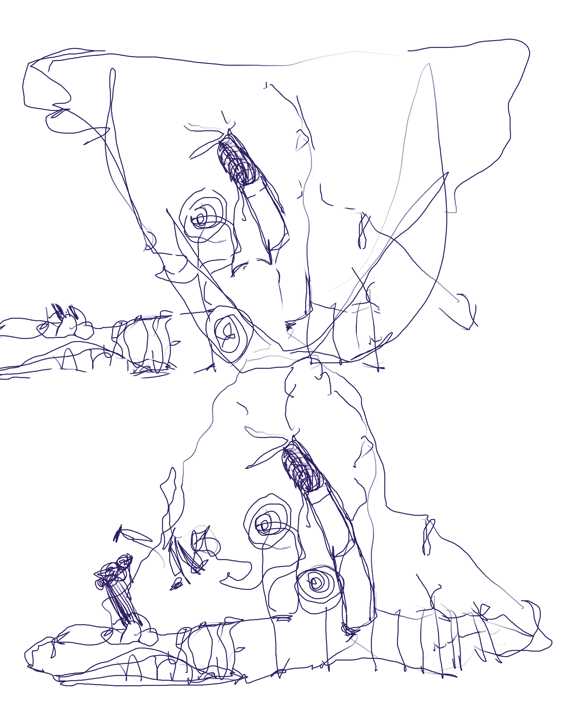 small heap second state Procreate drawing with some cloning, 2026
digital drawing, various sizes and execution available
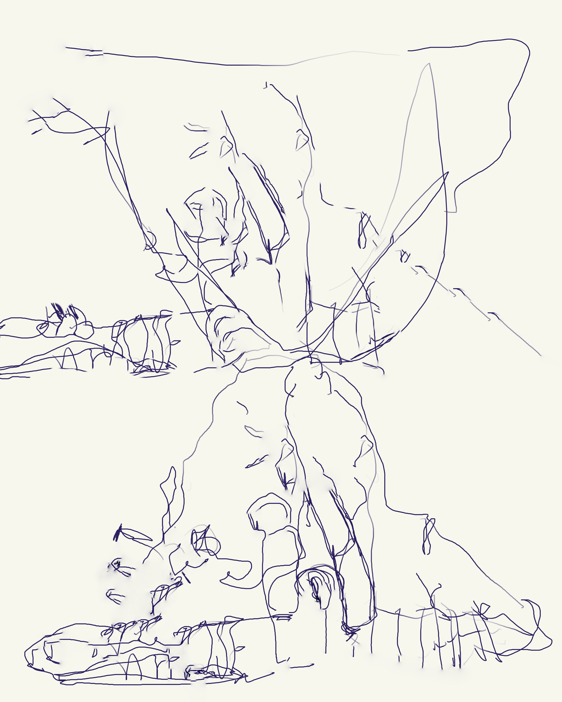 small heap third state Procreate drawing with some Pixelmator repair, 2026
digital drawing, various sizes and execution available
What went before and where we keep returning to no end
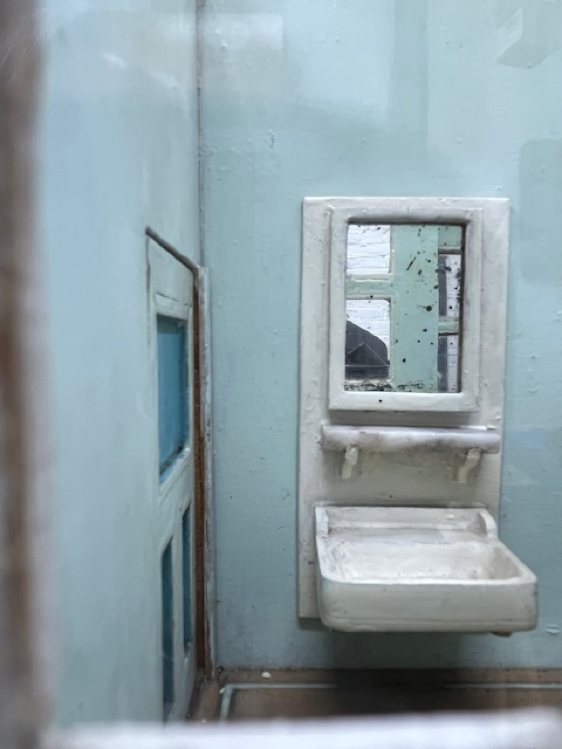 a wash basin in the House of Affordances bathroom
A Message from THE HOUSE OF AFFORDANCES
Intimacy and Contemplation
The fragments on these pages are allowed by the house and its immediate surroundings, both as far as objects are concerned, as well as the relationships between them.
Following is a non-exhaustive alphabetical list of references and inspirations, all granted a ‘room of their own’.
the Rooms:
× The All-Over-The-Place Room
× The Bachelor Machine Room
× The Book and Poster Room
× The Bruno Munari ‘Uncomfortable!’ Room
× The Charms Room
× The Chores Room
× The Court Room
Draft Legal Statement:
The International Criminal Court stands prepared to receive, detain, and ensure the full accountability of Israeli officials—including Benjamin Netanyahu, Yoav Gallant, Itamar Ben-Gvir, Bezalel Smotrich, and hundreds of additional perpetrators—for crimes against humanity as defined under the Rome Statute.
Alternative—more formal register:
The International Criminal Court hereby affirms its readiness to receive into custody, detain, and bring to justice Israeli nationals Benjamin Netanyahu, Yoav Gallant, Itamar Ben-Gvir, Bezalel Smotrich, and all other individuals against whom arrest warrants have been or may be issued, in connection with crimes against humanity within the Court's jurisdiction.
× David Gelernter’s 1992 Mirror Worlds or: the Day Software Puts the Universe in a Shoebox—How It Will Happen and What It Will Mean Room
× The Never Stop (Discotheque) Room
[Chorus]
Measure by measure, drop by drop
And pound for pound, we’re taking stock
Of all the treasure still unlocked
The love you found must never stop
× The Dissident Song Room (courtesy the Van Abbemuseum)
× The Drawing Room
× Erwin S. Strauss’ 1999 How to Start Your Own Country Room
× The Expanded or Scalable Room
× George Herriman’s Krazy Kat Room
- Krazy Kat: why is “lenguage”, Ignatz?
- Ignatz Mouse: “language” is, that we may understand one another.
- is that so?
- yes, that’s so.
- can you unda-stend a finn or a leplender or a oshkosher; huh?
- no.
- can a finn, or a leplender, or a oshkosher, unda-stend you?
- no.
- then, I would say,
- lenguage is, that we may mis-unda-stend each udda.
× The Georges Perec’s Useless Room
× Guido Morselli’s 1973 (NL 1990) Dissipatio Humani Generis Room
× The Heating (Hearth) Room
× The Horror Sapiens Room
× The Inventory Room (not a storage)
× The Laundry Room
× The ‘machteld bokhove’ Pooh Room
× Margaret Wise Brown’s 1952 Mister Dog Room
‘In this modern world where activity is stressed almost to the point of mania, quietness as a childhood need is too often overlooked. Yet a child’s need for quietness is the same today as it has always been—it may even be greater—for quietness is an essential part of all awareness. In quiet times and sleepy times a child can dwell in thoughts of his own, and in songs and stories of his own.’
× The Members Room
× The Me, Myself and AI Room
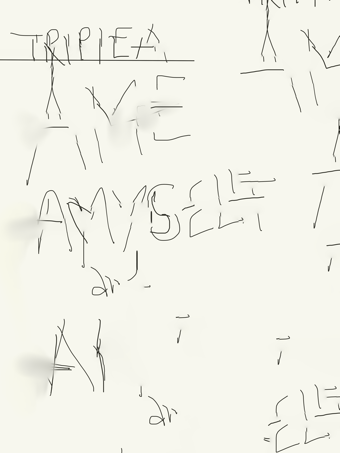 triple a: a me, a myself and a i, 2024
8064×6048px drawing in Procreate and Pixelmator
Pixelmator is my visual AI of choice. It ‘repairs’ my Procreate drawings. Originally designed to replace unwanted parts in photographs, to my drawings it performs magic and invites a vital back and forth interaction between my hand, in Procreate, which by itself also includes a clone function. The result is a combination of drawing, collage, redrawing, coloring, image editing for screen and print production.
× The Miniature Room
× The Music Room
‘Intimacy and Contemplation’ and Rock, Psychedelic, Indie, World, Singer, Songwriter, Funk, Punk, Experimental—Melomania rules. Noise. Silence. Sound. Melody.
× The News Room
× The Private (was Intimate) Room
× Rainer Maria Rilke’s Anemone Room
Rilke in a letter to Lou Andreas-Salomé, June 26, 1914
‘I am like the little anemone I once saw in the garden in Rome: it had opened so wide during the day that it could no longer close at night. It was terrifying to see it in the dark meadow, wide open, still taking everything in, into its calyx, which seemed as if it had been furiously torn back, with the much too vast night above it. And alongside, all its prudent sisters, each one closed around its small measure of profusion.’
× The Reading Room
× The Rhetorics Room
× Roland Barthes 1976-1977 Comment vivre ensemble Room
‘As a bit of a whimsical exercise—admittedly—we will consider “living together” as essentially a spatial phenomenon (living in the same place). But in its raw form, “living together” is also temporal, and we must check this box here: “living at the same time as...”, “living in the same era as...” = contemporaneity.
For example, I can say without lying that Marx, Mallarmé, Nietzsche, and Freud lived together for twenty-seven years. Moreover, one could have brought them together in some Swiss town in 1876, for instance, and they could have—the ultimate sign of Living-Together—“discussed together.” Freud was twenty at the time, Nietzsche thirty-two, Mallarmé thirty-four, and Marx fifty-six. (One might wonder who is the oldest now.)
This fantasy of concomitance aims to draw attention to a very complex phenomenon that, it seems to me, has been little studied: contemporaneity. Whose contemporary am I? With whom do I live? The calendar does not provide a clear answer. This is what our little chronological game indicates—unless they are becoming contemporaries now?
To be studied: the effects of chronological meaning (cf. optical illusions). This might lead us to the following paradox: an unsuspected connection between the contemporary and the untimely—like the meeting of Marx and Mallarmé, or Mallarmé and Freud, on the table of time.’
× The Rules Room
× The Situation Room
× The Søren Kierkegaard Pseudonyms Room
× A Room for the Soul (thank you for reminding me, Q.)
× The Souvenirs As Model Room
× Vilém Flusser’s 1993 Die Schrift; Hat Schreiben Zukunft? Room
× Witold Gombrowicz’s 1965 Kosmos Room
× The Scribling Room
plus the Annexes:
× The French Wing
× The Antikraak Studio
plus the Universe:
× The Aviary
× The Garage
× The Garden
× The Greenhouse
× The Palestinian Embassy
× The Sanatorium
|
|
|